Baroque Catania & home
A last swim, the city Vaccarini built out of the rubble, and a 21:00 flight
- Piazza del Duomo
- The Badia dome
- Via dei Crociferi
- Monastero dei Benedettini
Check-out is at 10:00 and the flight is not until 21:00 — but the hire car is ours until the evening, which turns an awkward eleven-hour gap into the best walking day of the week. On 11 January 1693 an earthquake destroyed Catania and killed something like two-thirds of the people in it. What went up afterwards was not a repair but a new city, planned on a grid of wide straight streets and large open squares because wide streets are what you can run down, and built almost entirely between 1700 and 1780 in one idiom. From 1730 one man ran it: Giovanni Battista Vaccarini, Palermo-born, Rome-trained, who gave Catania its cathedral front, its elephant, its university square and half its churches. This is a walking tour of that city — UNESCO lists it with Noto, Ragusa and Modica as the Late Baroque Towns of the Val di Noto — with Sunday lunch in the middle and Fontanarossa at the end.
What it looks like
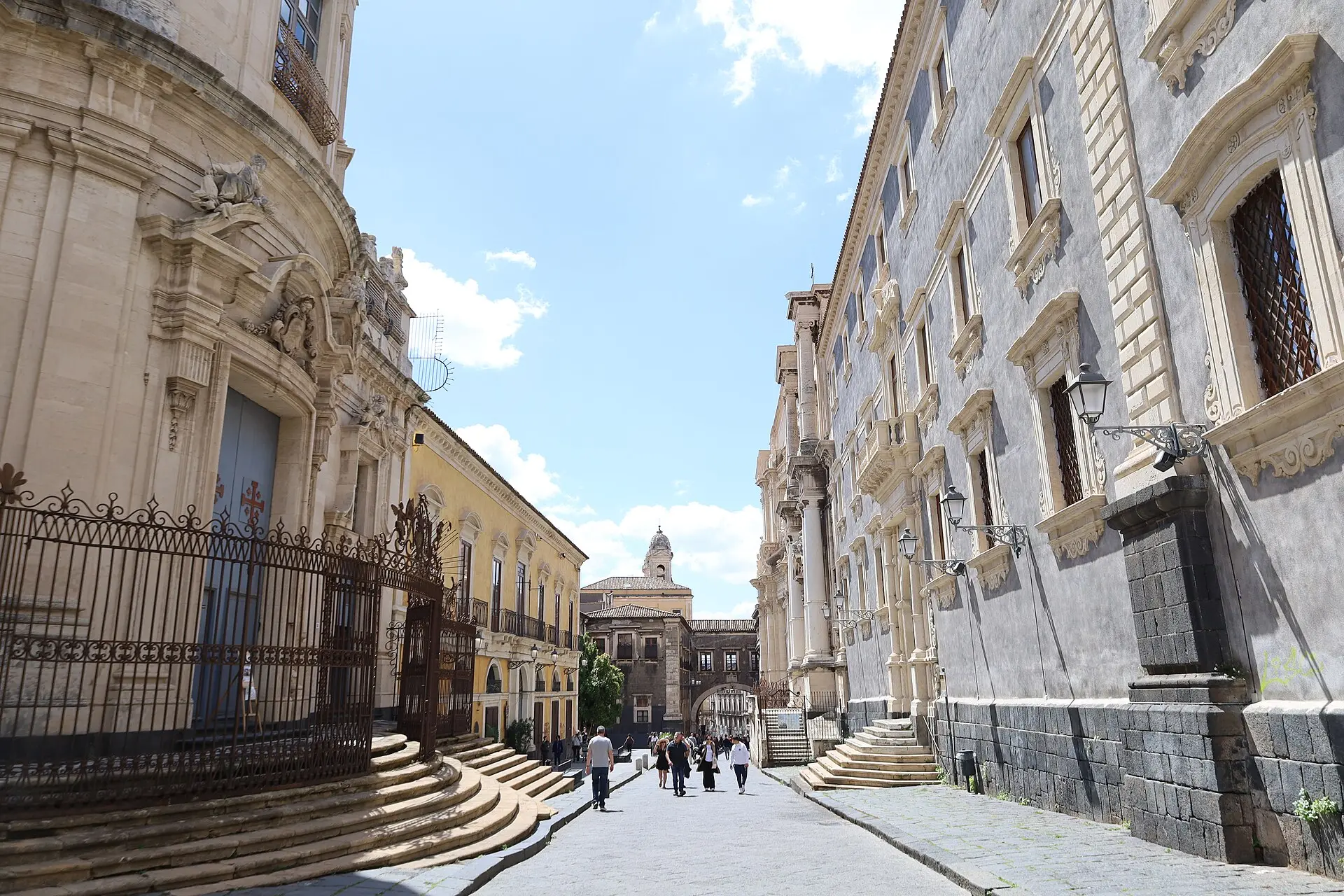
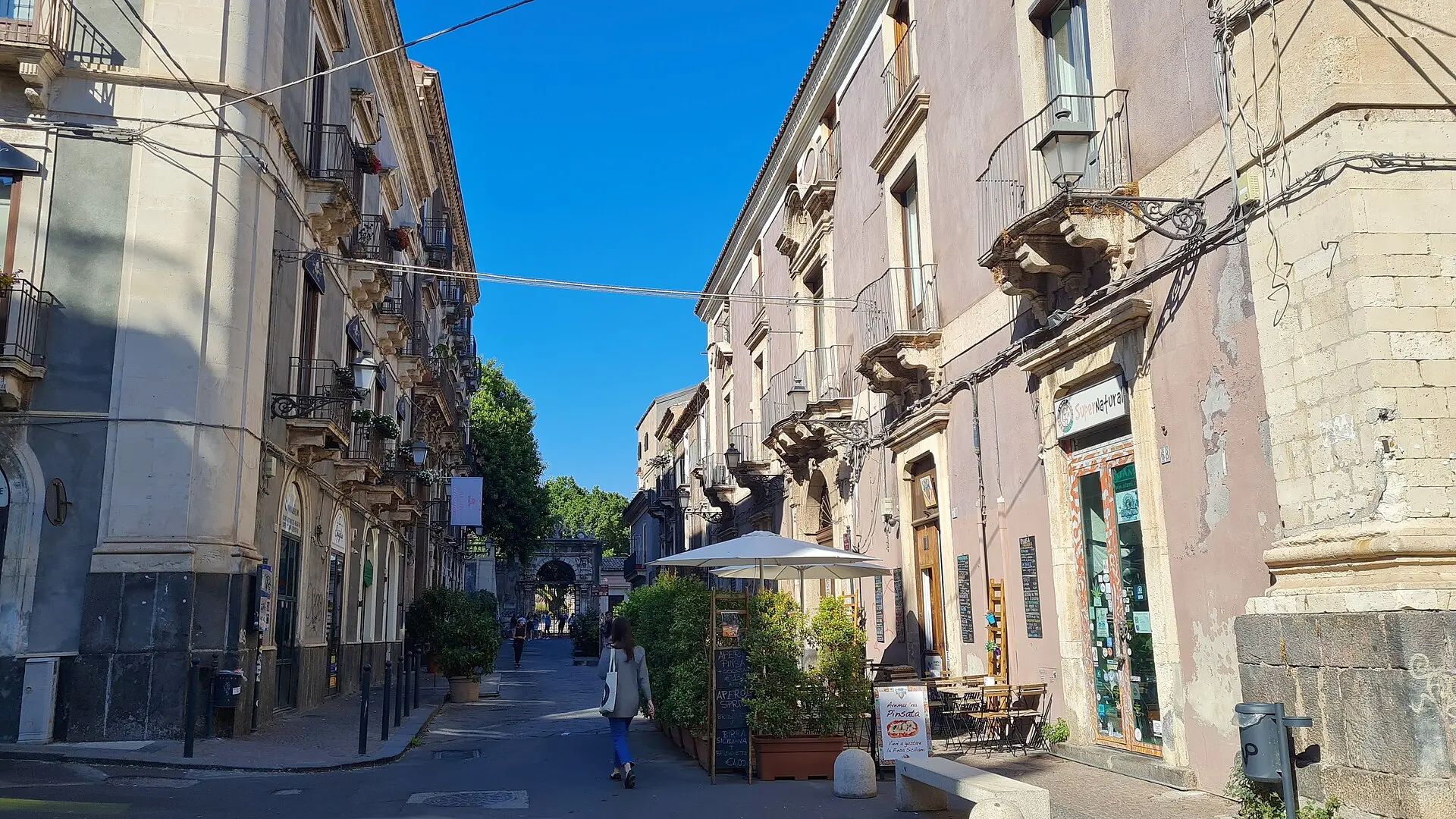
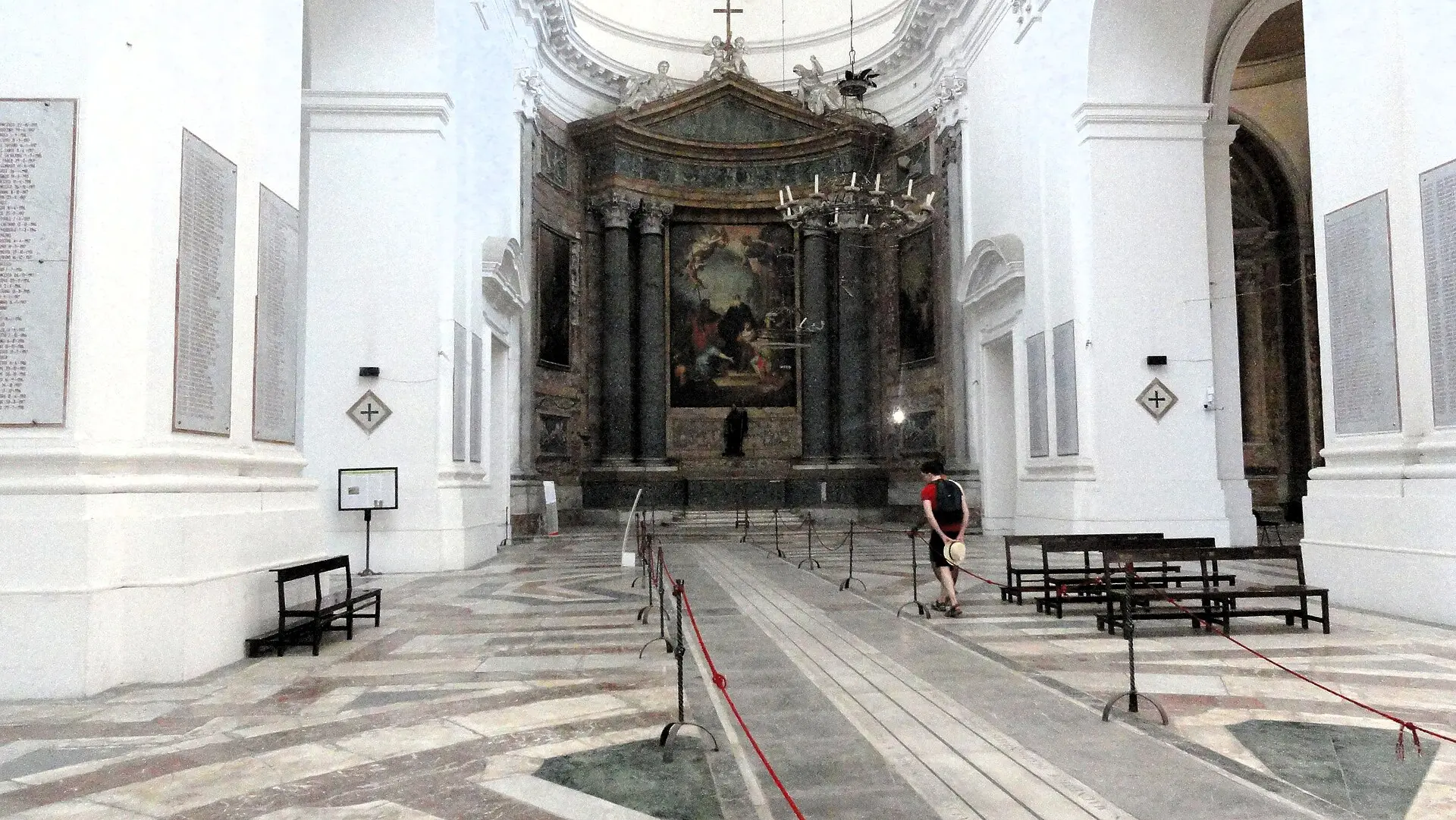
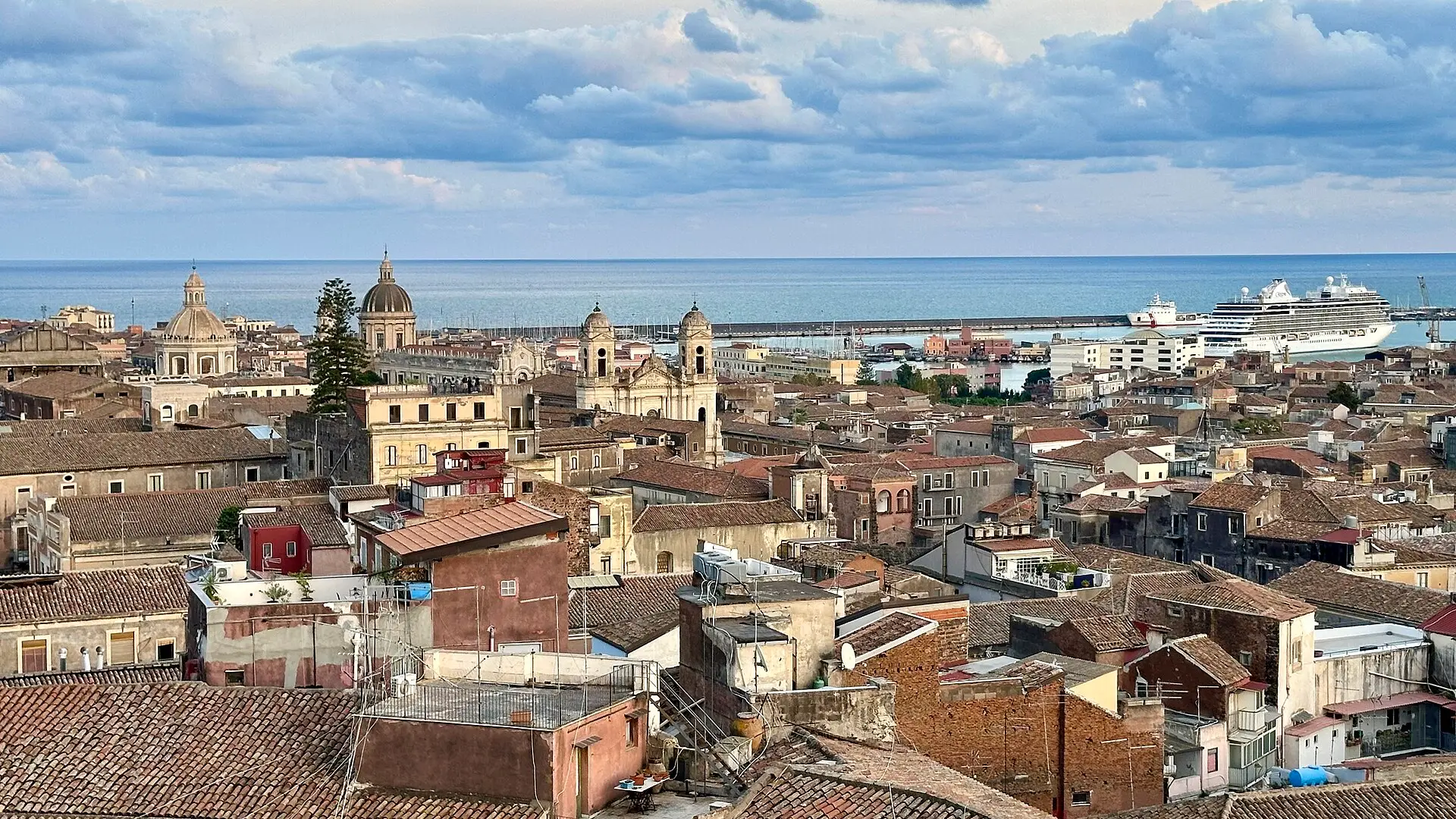
The lower end of the street, running up to the Villa Cerami gateDerbrauni · CC BY 4.0 Inside San Nicolò l’Arena — the meridiana runs across the floorEffems · CC BY-SA 4.0 Catania from the roof of San Nicolò, down to the portFlorent Abel · CC BY-SA 4.0
The route
8 stops, by car
Open in Google MapsThe day, hour by hour
- 07:3007:30
A last swim
End of Via Livorno
The rocks at the end of the street one final time, before the sun is properly up and while the village is still asleep. There is no better way to start a travel day, and the whole rest of it is spent in a car, a shop and an airport.
Sea1 h 30MapRinse the salt off and pack the wet things somewhere they can be got at — the towel will still be damp at check-in.
- 09:1509:15
Check out and load the car
Via Livorno 13
Keys back by ten. Everything from here happens out of the boot, so pack in the order you will want things: the swimming stuff at the bottom, the shopping space at the top.
Pause45 min - 10:0010:00
Into Catania
Aci Trezza → Catania
Twenty minutes down the coast for the last time. Sunday morning is the one time the city is easy to drive into and easy to park in.
Drive30 minUse an attended garage rather than the street — the car is carrying everything we own for the next eleven hours, and it does not move again until six.
- 10:3010:30
Piazza del Duomo — reading Vaccarini’s square
Piazza del Duomo
Day 1 crossed this square in a hurry and went into the cathedral. Today we stand still in it, because it is a single designed composition and it repays being read as one. Vaccarini gave the Duomo its façade in 1736 using granite columns salvaged from the Roman theatre; he set U Liotru, the lava elephant with its Egyptian obelisk, on the fountain in the middle the same year; and he finished the Palazzo degli Elefanti along the north side. The Amenano fountain at the south-west corner spills over a marble lip into the river of the same name, which runs under the whole square and surfaces in the fish market.
Sight30 minFreeMapStand with your back to Porta Uzeda and look north. Everything you can see — the cathedral, the palace, the seminary, the pavement pattern — went up inside eighty years, which is why it agrees with itself so completely.
- 11:0011:00
Up the dome of the Badia di Sant’Agata
Via Vittorio Emanuele II 182
Vaccarini’s own church, finished in 1767 and generally reckoned his best building — a small, tight, convex front squeezed into the street beside the cathedral. The dome was the first raised in the rebuilt city, and you can climb it: about 160 steps, or a lift most of the way. From the terrace the whole of Piazza del Duomo is laid out underneath you, with the port on one side and Etna on the other.
View45 min€3MapSunday daytime access runs roughly 09:00–12:00, so this has to be the late morning — the afternoon slot on a Sunday does not open until 19:00, by which time we are at the airport. About €3.
- 11:4511:45
Via dei Crociferi
From the Arco di San Benedetto to Villa Cerami
Two hundred metres of street with four churches and a monastery on it, all built within about forty years of each other, and the single reason Catania is on the UNESCO list. You enter under the Arco di San Benedetto — thrown across the road in 1704, supposedly in one night, to link the Benedictine nuns’ two convents. Then San Benedetto, whose plain door hides a barrel vault covered end to end in frescoes; San Francesco Borgia, up a pair of curving flights; the Jesuit college beside it, round a courtyard of black-and-white lava paving; and San Giuliano, Vaccarini again, with a convex front that bulges into the street and a belvedere above the cornice. The street ends at the gate of Villa Cerami under the trees.
Walk1 h 15FreeMapSan Giuliano is open daily 10:00–18:30. San Francesco Borgia does Sunday 09:00–13:00 and 15:00–18:00. The others are more casual about it — take what is open and enjoy the street either way, since the point of Crociferi is the sequence rather than any one interior.
- 13:0013:00
Sunday lunch, at length
Around Piazza Dante
The one meal Italy takes most seriously, and the last one we get. Pasta alla Norma — fried aubergine, tomato, salted ricotta, named after the Bellini opera by a city that is very proud of both — and then whatever the fish counter had on Saturday, because there is no market today.
Food1 h 45Book on Saturday, and book something near Piazza Dante: the monastery tour starts at three and it is worth not having to hurry the coffee.
- 15:0015:00
Monastero dei Benedettini — the guided tour
Piazza Dante 32
The second-largest Benedictine monastery in Europe, rebuilt after 1693 at a scale that scandalised even the order, and now the university’s humanities faculty — so it is a working building full of students rather than a museum. The tour goes through both cloisters, the vaulted kitchens, the excavated Roman house under the floor and the lava flow of 1669 that the monks simply built on top of. Attached to it is San Nicolò l’Arena, the biggest church in Sicily and the strangest: begun, interrupted, and never finished, so the front is still bare stone with the stumps of columns sticking out of it. Inside, a meridian line inlaid in 1841 runs across the floor, lit by a hole in the dome at noon.
Sight1 h 15€10MapTours run hourly, 15:00–18:00 on a Sunday, about 75 minutes, €10, and must be booked — Officine Culturali take a WhatsApp. Worth doing today specifically: at weekends the route includes the abbot’s apartments, which it does not on a weekday.
- 16:3016:30
Down Via Etnea — and everything that has to fit in the suitcase
Piazza Università → Piazza Stesicoro
The last of the baroque, folded into the shopping, because it is all on one street. Piazza Università has Vaccarini on both sides — the university itself and Palazzo San Giuliano facing it. A hundred metres up, the Basilica della Collegiata hides behind a concave façade by Stefano Ittar that is the most purely theatrical thing in the city. Then: pistachio from Bronte, salted capers, dried oregano on the stalk, almond paste, bottarga, a bar of the Modica chocolate, a bottle of Etna Rosso, and a last granita standing at a bar counter.
Market1 h 15MapThe Pescheria and the Fera ’o Luni are both Monday to Saturday, so Sunday shopping is shops rather than markets. Vacuum-packed cheese and bottarga are fine in the hold; nothing liquid goes in the cabin.
- 18:0018:00
Drop the car at Fontanarossa
Aeroporto di Catania (CTA)
Twenty-five minutes from the city, plus fuel on the way and the walk back from the rental return. Fontanarossa is small, so being airside by half past seven is comfortable rather than tight.
Drive45 minMapFill up before you get there — airport fuel is the usual robbery, and most contracts want the tank returned full.
- 21:0021:00
Fly home to Milan
Catania → Milan
Out over the Ionian with Etna on the left if the seat is on the right side of the aircraft. Seven days, five baroque cities, one volcano seen from every angle but the top, and a bag that smells faintly of oregano.
Pause